Check a pairing before you breed.
See carrier risk for the conditions both animals have been tested for, and the inbreeding coefficient from their pedigrees. Then rank mates, plan a season, and keep a record of what you decided.
Breeding tools come with Client Pro.
Pairing check
Juniper × Blue Ridge Cody
Quarter Horses
- HYPP · clear × clearNo affected foals
- HERDA · carrier × carrier25% affected
- Pedigree COI3.1% · 2 shared ancestors
What you can do
The checks and plans you make before a breeding.
Each answer shows what it was based on, so you can judge how far to trust it.
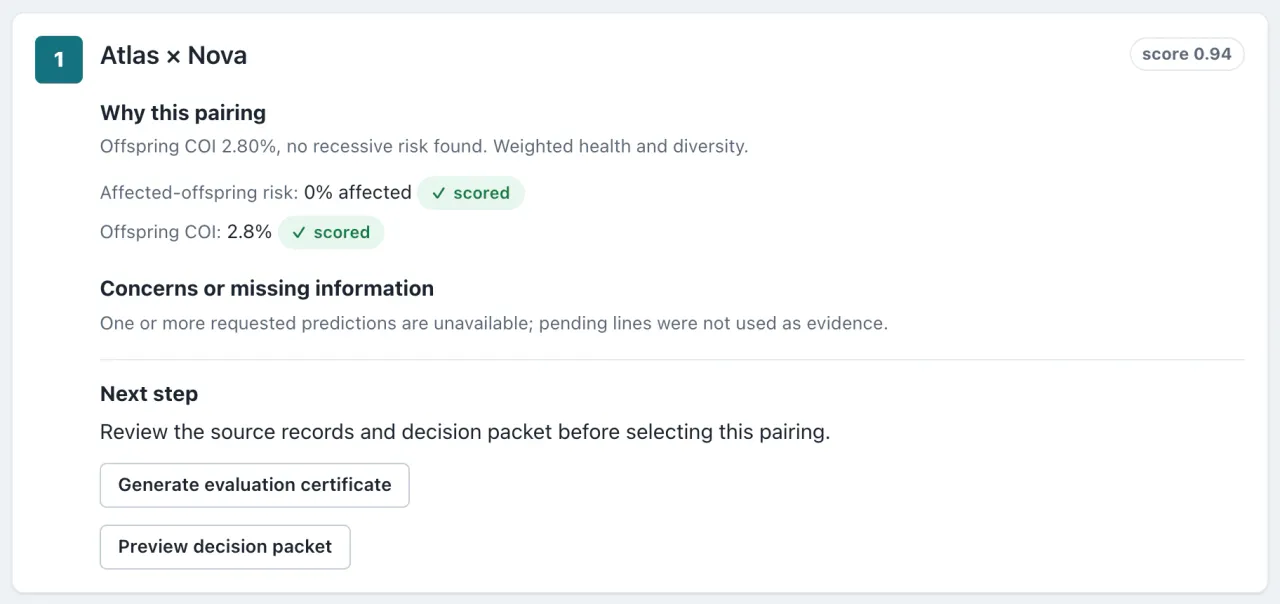
Carrier risk for a pairing
See the chance of affected, carrier, or clear offspring for each condition both animals have lab carrier results for.
Inbreeding (COI)
Get the pedigree inbreeding coefficient for a pairing in the pairing simulator, with the shared ancestors behind the number.
Mate ranking
Rank candidates for one animal with the reasons shown. Filter out at-risk pairings and set a limit on inbreeding.
Describe a goal in your own words
Type what you are after, such as a health requirement or an inbreeding limit, and see how each part was read before anything is ranked.
Season planning
Lay out a season of pairings and see where inbreeding is heading over the next generations.
Diversity planning and genetic rescue
See how much each animal should contribute to keep a line diverse, and which outside animals would add the most new diversity.
Decision journal
Record what you decided and why, and add the outcome later, against the evidence you had at the time.
Watches
Save a breeding plan or search and hear when a new candidate fits it.
What the checks use
A check can only cover what's on record.
Fill the gaps first, and the checks get more useful. AnimalTrace shows you which gaps matter.
- Carrier risk uses the lab carrier results on record for both animals. A condition that hasn't been tested on both sides can't be checked. Results you bring in from old reports appear on the record now; using them in pairing checks is coming.
- Inbreeding comes from the pedigree on record. Ancestors that aren't recorded can't be counted, so an incomplete pedigree makes COI look lower than it is.
- Rankings follow the goal you set. There is no universal breeder score.
Planned
What we're working on next.
These aren't available yet. We'll say so here when they are.
Parentage and relationship checks from DNA
Confirming a parent or estimating how two animals are related from their genotypes.
Uploaded reports in pairing checks
Using results from reports you upload, labelled as owner-supplied, alongside lab-reported results.
Sample mix-up detection
Flagging a likely sample swap before it affects anything downstream.
Questions
About the breeding tools.
What is COI?
Which species and conditions are covered?
Does it tell me which pairing to make?
New to this? Read Inbreeding coefficient, explained and Recessive-risk pairing, before you breed, and How to read a genetic test result. Step by step in Help: check a pairing and rank mates and pairings.
Bring in your breeding animals' records.
Start free, then add Client Pro when you're ready to check pairings. Running a larger program? Ask about a pilot.