One parent link, five changed pairings: a pedigree sensitivity study
Research note · Pedigree record sensitivity
Abstract
A pairing calculation can change when a parent is added to a pedigree, even if neither animal in the pairing has been edited. We tested that effect in the published pedigree of 237 dogs. For each of its 419 recorded parent links, we hid that one link, recalculated the expected offspring pedigree coefficient of inbreeding (COI) for the same 30 distinct recorded sire–dam pairings, and compared the result with the complete available file. Nineteen link omissions changed at least one pairing. Thirteen changed more than one; two changed five pairings each. In six omission scenarios, at least one nonzero pairing appeared to have zero COI. These are deterministic results for one research pedigree, not estimates of how often registry records change.
The question behind an update
When a record gains a parent, it is clear that the animal’s own pedigree has changed. The less obvious question is how far that correction reaches. A parent can connect a descendant to an ancestor shared with other breeding lines. Pairings checked before the connection was visible may then need a new calculation.
Our earlier pedigree-depth study showed what happens when we shorten ancestry by generation. Here we held the set of pairings fixed and changed one known parent link at a time. This isolates the effect of a single missing connection in the recorded pedigree.
Data and method
We used the sample IDs and parent fields in the public pedigree file accompanying Campbell et al. (2016). The 237 dogs include 207 with two recorded parents, five with one, and 25 with neither. The 207 two-parent offspring come from 30 distinct recorded sire–dam pairings. Multiple offspring of one pair count as one pairing in this analysis.
We calculated each pair’s expected offspring pedigree COI as half the tabular relationship between its sire and dam. Unknown parents contribute no recorded relationship. Starting from the full available file, we removed each recorded sire or dam link in turn, recomputed the relationship matrix, and compared all 30 pairings with the full-file values. The pairings remained in the comparison even when the omitted link belonged to an animal in one of them. We checked that every recorded offspring’s matrix diagonal agreed with the value from its parents and that hiding a link did not raise any pairing’s COI.
This is a counterfactual record test: we do not know when the source links were first recorded, and we did not observe 419 real-world updates. We did not use SNP genotypes, disease results, dates, or clinical outcomes.
Results
| Recorded parent links hidden one at a time | Link omissions |
|---|---|
| No change to any of the 30 fixed pairings | 400 |
| Changed one pairing | 6 |
| Changed two pairings | 11 |
| Changed five pairings | 2 |
| Total parent links tested | 419 |
Across all scenarios there were 38 changed link–pair comparisons. This counts a pairing again if a different omitted link also changes its result; it does not mean 38 independent pairings. Six link omissions made at least one pairing with a nonzero full-file COI read as zero. “No change” here means no change among the 30 recorded pairings evaluated, not no effect on every possible future pairing.
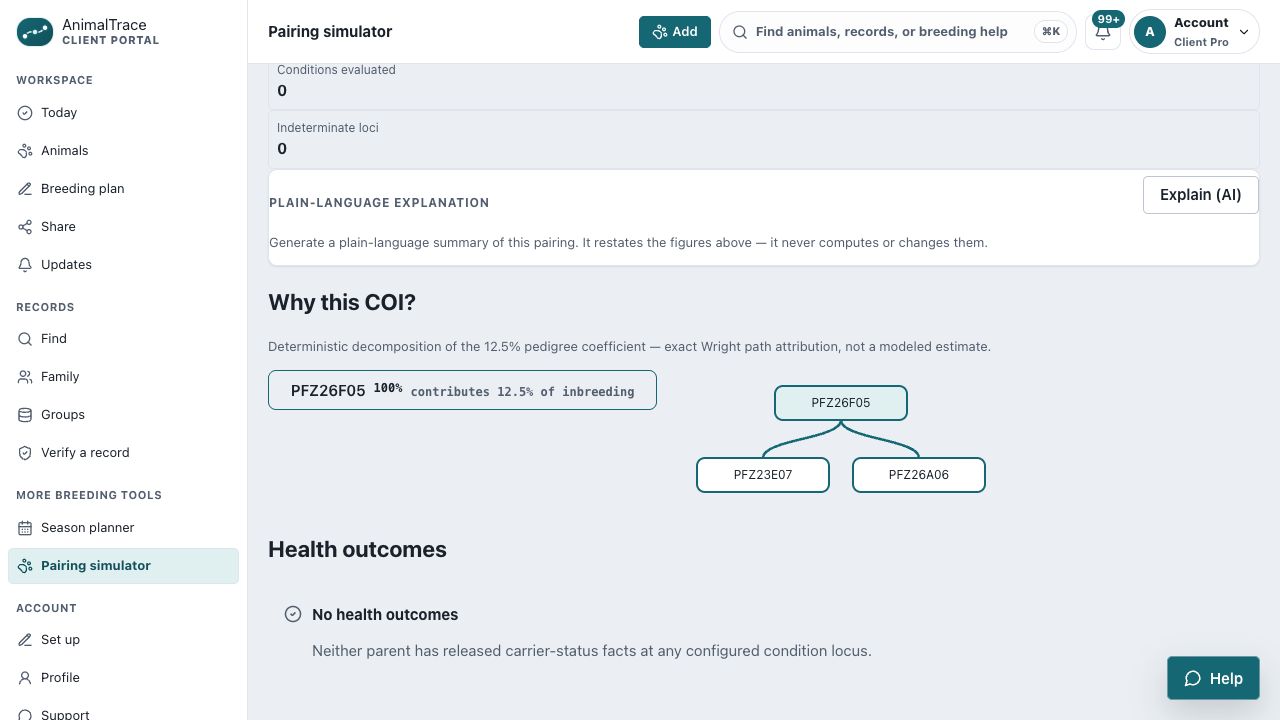
One example shows why the reach can be wider than the edited animal. In the full file, PFZ26F05 is recorded as the sire of PFZ23E07. Hiding that one link changed all five pairings with nonzero full-file COI:
| Recorded sire × dam | COI with link hidden | COI with full available record |
|---|---|---|
| PFZ19E09 × PFZ18D01 | 31.64% | 36.33% |
| PFZ19E09 × PFZ19G09 | 13.28% | 16.41% |
| PFZ23A05 × PFZ23A07 | 0.00% | 3.13% |
| PFZ23D07 × PFZ23A06 | 0.00% | 3.13% |
| PFZ23E07 × PFZ26A06 | 0.00% | 12.50% |
The same five pairings change if we instead hide PFZ26F05 as the sire of PFZ26A06. That is a property of this family structure: each omitted link removes a recorded path through a shared ancestor. In the full file, the pairing PFZ23E07 × PFZ26A06 has a 12.5% expected offspring pedigree COI; without either of those two links, it appears as zero in this calculation. The table is rounded for reading; the pair-level results retain eight decimal places in percent units.
What this means for search, updates, and matching
A notice about a parent link identifies the record to inspect. It does not by itself list every prior pairing whose calculation might have changed. This experiment gives a concrete reason to follow the line beyond the edited animal: a link to a shared ancestor changed up to five of the recorded pairings we checked. A useful review sequence is to verify the source of the parent link, find affected descendants and saved pairings, then rerun Match with the current pedigree.
A zero based on missing ancestry must still be read as zero within the available record. Restoring one link turned three apparent zeros into nonzero values in the five-pair example. Neither the old nor the revised pedigree COI is a genomic inbreeding measurement or a health prediction.
Scope and reproducibility
This is one Labrador Retriever–Greyhound research colony, not a random sample of dogs, breeders, or registries. Its founder records do not trace ancestry beyond the file. The 419 omission scenarios share the same pedigree and often affect the same pairings, so we do not treat them as independent observations or report a significance test. We cannot infer an update rate or a time trend because the pedigree fields used here contain no dates. The results demonstrate how record completeness can alter a calculation, not which mating should be chosen.
- Source study: Campbell et al., 2016, A Pedigree-Based Map of Recombination in the Domestic Dog Genome.
- Source data: Authors’ public repository,
new_pedigree_dogs.faminsidedog_genotype_data.tar.gz. - Derived data: All 419 link-level results and all 38 changed link–pair comparisons.
- Method: Download the standard-library Python script to repeat the one-link omissions and matrix calculations.
This AnimalTrace research note has not undergone external peer review. For a worked product example using these public records, see Search, Updates, and Match in a published dog pedigree.