AnimalTrace Search and Match in a published dog pedigree
What changes when a breeding record gains a parent, or when two possible sires have different amounts of recorded ancestry? We put a published canine pedigree into AnimalTrace to follow that question through Search, Updates, and Match. The exercise is small enough to inspect animal by animal, but substantial enough to show why a match depends on the evidence behind it.
A family we can trace to its source
Campbell and colleagues’ 2016 study describes 237 dogs from a Labrador Retriever–Greyhound research colony. Its supporting pedigree data provide sample IDs, sex, and recorded parents. We loaded a 40-dog family subset into a local AnimalTrace instance, keeping the published sample IDs as the animal names. The subset includes two recorded sire–dam combinations, their 32 offspring, and the ancestors needed to examine those pairings.
We did not add birth dates, breeding availability, or disease-test results: those facts are absent from the pedigree fields used here. The source includes genome-wide genotype data, but we did not turn those calls into clinical carrier statuses.
Find the record, then follow the question
Searching for PFZ23E07 returned a matching row with its sample ID and species. We checked that ID against the source pedigree, saved the search, and followed it for pedigree changes. When the published parent link was added, the watch surfaced PFZ23E07 for review. A watch follows matching records, so each update still needs an ID and source check.
Review the source parent record, then rerun any pairing that uses this animal.
That update answers a narrow question: which watched record changed? It does not say whether a mating is suitable. A breeder or registry can inspect the new parent link, check its source, and then run the affected pairing again.
Two pairings, two different readings
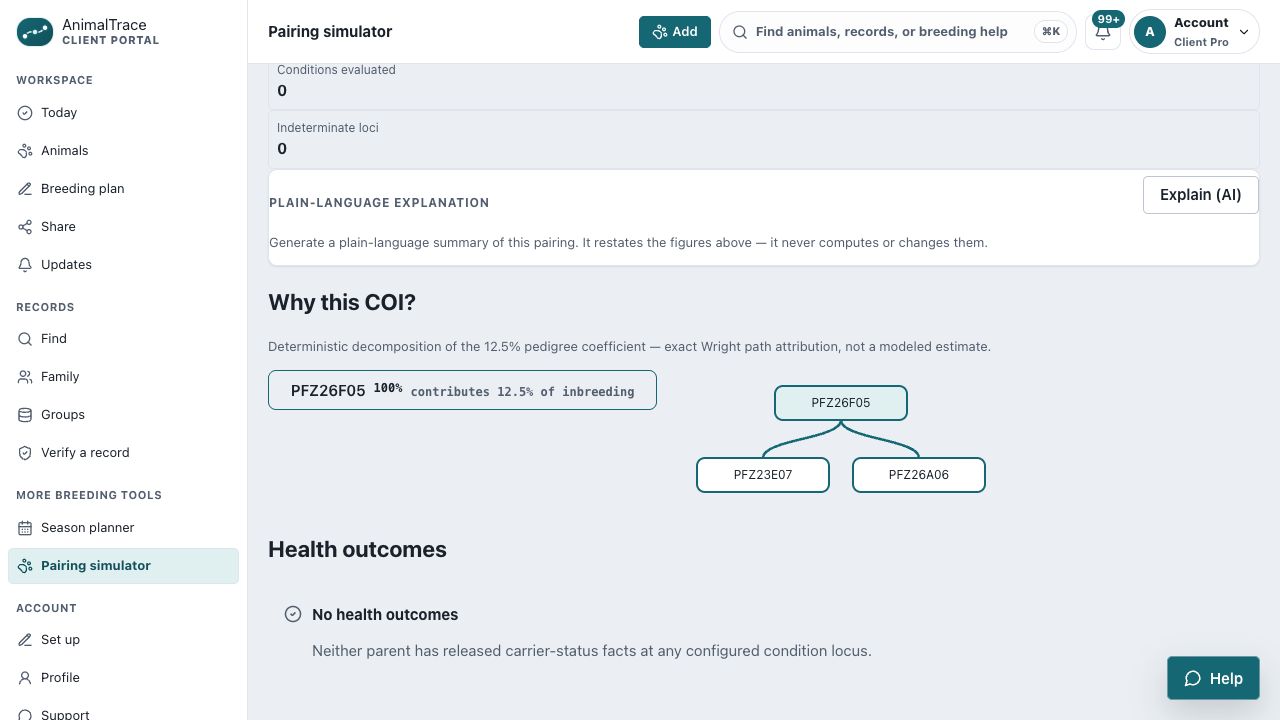
We used AnimalTrace’s pairing simulator on two sire–dam combinations recorded in the source pedigree. The dam, PFZ26A06, is the same in both. The comparison exposes both a result and a gap:
AnimalTrace traces the contribution to shared recorded sire PFZ26F05.
The source lists no parents for PFZ24C06. AnimalTrace flags the missing sire-side pedigree depth.
The 0.0% is not evidence that the second pair is genetically unrelated. It means the available pedigree has no shared ancestor for the calculation, while one side ends at an undocumented founder. Neither pairing produced a condition-specific health outcome in this exercise because no released disease results were loaded. These were historical pairings in a research colony, not a recommendation to repeat either mating.
A line pattern worth watching
Among the 32 offspring in this family subset with PFZ26A06 recorded as dam, 28 have PFZ24C06 recorded as sire and four have PFZ23E07. That difference is a count of records in this colony. It is not a breed-wide frequency, a measure of genetic quality, or a trend over time: the pedigree file does not provide dates for these animals.
For a breeding program, the useful habit is to keep the denominator and the family context beside any rising count. A registry could ask whether new records keep concentrating in one line, whether parentage coverage changes, and whether a corrected ancestor alters previously checked pairings. Search defines the records to inspect; a saved watch brings a relevant change back into view; Match makes the pair-specific calculation with the evidence currently available.
What this exercise taught us
A change notice should identify the record and the reason for review. A pairing result should reveal both the ancestor behind a nonzero COI and the missing ancestry behind a zero based on incomplete records. Those are different kinds of information, and they lead to different next steps. Keeping them visible is how a breeding shortlist remains useful as new evidence arrives.
Method. Counts above come from the pedigree fields in the authors’ public data. We loaded the selected family into a local AnimalTrace instance, saved a search and watch, added the source parent links, and ran the two pairings through AnimalTrace’s pairing simulator. The watch surfaced PFZ23E07 along with two other sample IDs meeting the saved search during the import. This is a worked record analysis, not a performance or clinical validation study.
For the full depth comparison behind this example, see our pedigree research note. Explore AnimalTrace breeding tools and learn how Updates works.