How to keep a breeding plan current
A good match is a decision made with the evidence available today. A new lab result, a corrected pedigree, or an available animal from another line can change the options before the mating takes place. The strongest breeding plans make room for that change without losing sight of the original goal.
That is the distinction behind AnimalTrace’s pairing planner and saved updates: compare the eligible pairings with current records, then keep the criteria so you know what to revisit when something changes.
Decide what matters before ranking candidates
Start with the conditions and limits that matter to your program. Which hereditary risks must the pairing avoid? How much relatedness is acceptable based on the pedigree you have? Are there age, registration, or availability requirements? Then consider the broader goals for the line, including health, type, performance, and the range of animals you want contributing to its future.
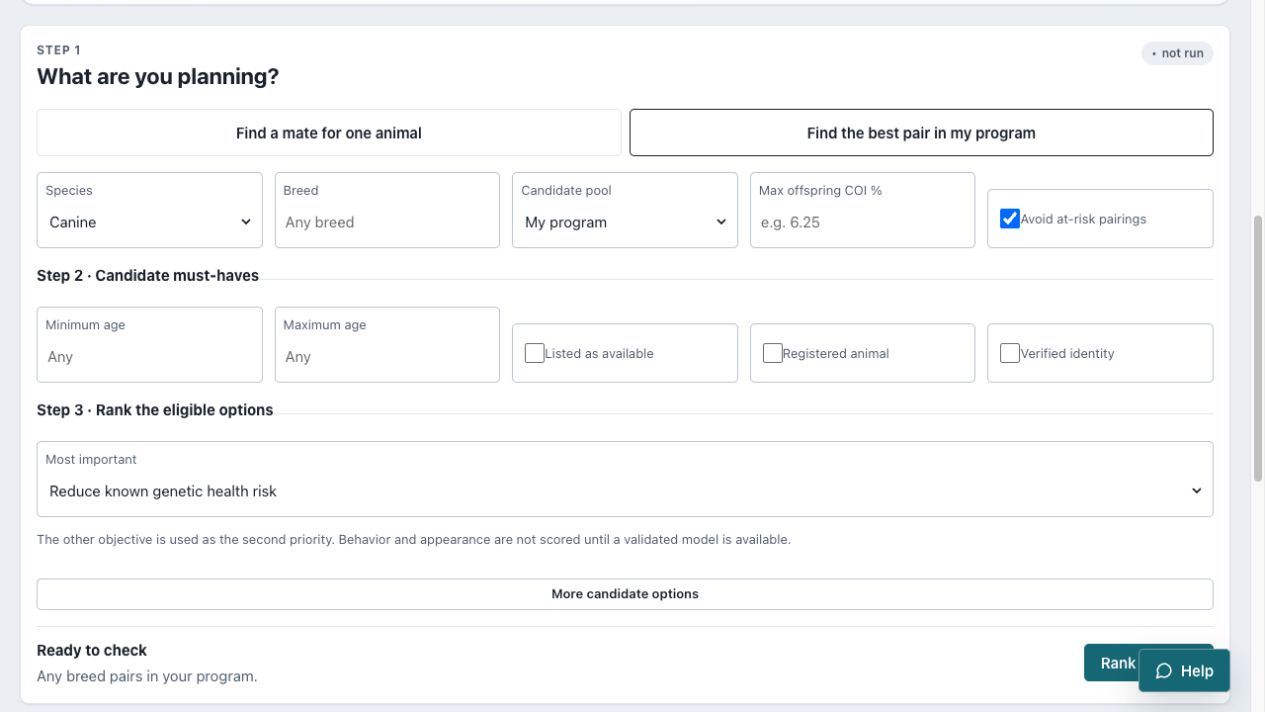
A search narrows who may be considered. A pairing assessment asks a different question: how a candidate compares with the particular animal or animals in the plan. A filter alone cannot establish offspring risk for a pair.
AnimalTrace lets you rank eligible mates or pairings against a goal you set and see the reasons and missing information behind the results. A ranking makes options easier to compare; it does not replace the breeder’s judgment, a veterinary assessment, or the traits that are not captured in a record.
Review the whole line, not only one pairing
A single mating can look sensible while a program gradually leans too heavily on one family. Repeated use of the same sire or close relatives makes future mates harder to find without increasing relatedness. Published work on pedigree dog health and Thoroughbred genomic diversity shows why the contribution of influential sire lines deserves attention.
Before finalizing a season, look at the proposed matings together. Ask whether several share the same recent ancestors, whether one animal is carrying too much of the next generation, and whether an alternative pairing preserves more options for later. AnimalTrace’s season and diversity planning tools help put those questions beside the individual pairing checks. Our guide to popular sire syndrome explains the longer-term risk.
Know what should trigger another look
A saved plan needs a review when the evidence behind it changes. Three common triggers are:
- A new or corrected result. Check whether it changes the conditions that can be evaluated for both animals. Compare the original lab reports if two sources disagree.
- A pedigree update. A newly recorded parent or ancestor can change the picture of relatedness. Recheck the pairing rather than relying on an older COI figure.
- A new candidate. An available animal can widen the shortlist. An animal from another program appears in network discovery only when its owner has opted in and the record is available to you. Compare it with the current options before changing the plan.
An untested condition is still unknown, even if every available result is clear. Likewise, a pedigree COI only reflects the ancestors recorded so far. Keep those gaps visible when comparing candidates, especially if a new report or pedigree entry changes what can be checked.
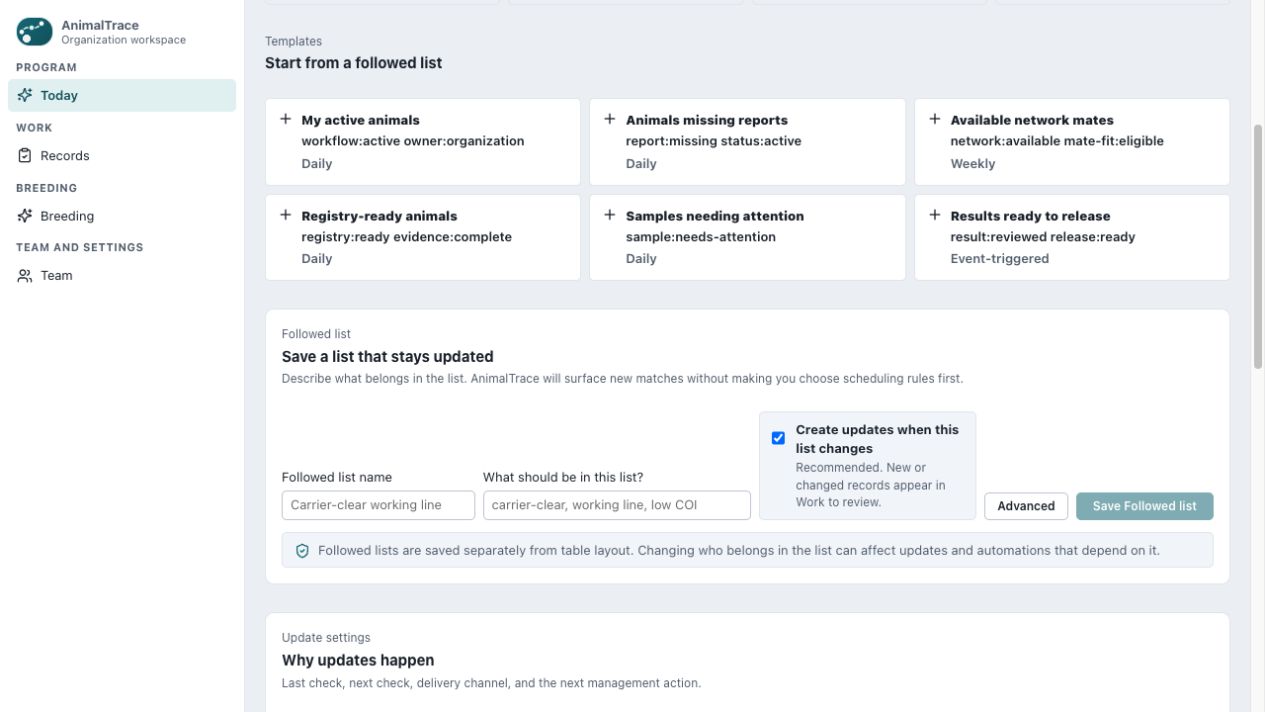
A saved breeding goal preserves the criteria behind a plan. A watch can call attention to a changed animal in its permitted candidate pool. That signal is a reason to run the pairing assessment again; it is not a fresh assessment of offspring risk or the best mate. Before a mating, confirm that the reports, clearances, pedigree, and animal details still describe the animals in front of you.
Teams can use a followed list in AnimalTrace Updates to bring relevant records back for review. The list helps organize that work; the pairing assessment still has to be run with the current evidence.
What breeding research tells us about changing records
Pedigree depth affects what a relatedness calculation can see. A study across dog breeds found historical pedigrees were often incomplete and that pedigree measures did not always reflect genome-based measures of diversity. Researchers studying Lipizzan horses found that a five-generation pedigree measure missed some more distant shared ancestry. Neither study provides a universal adjustment for another breed or an individual pairing. Both show why the depth and quality of the record matter when interpreting a COI.
The question in a genetic search must be equally precise. A clear result at one marker cannot answer a question about another marker. When released results at the named marker disagree, the value is unsettled for that search, not a clear finding. AnimalTrace’s condition-specific search uses this distinction to narrow a candidate list without mistaking it for a pairing assessment.
Adding a parent or correcting an ancestor can change the recorded relationship between two potential mates. The animals have not changed; the information available for the decision has. A plan made before that correction deserves a fresh pairing check, with the earlier assessment kept as part of the decision history. The same principle applies when a result arrives for a condition that could not previously be evaluated for both animals.
Keep the decision and the outcome together
Write down why you chose a pairing and what information you still lacked. When the litter or foal arrives, record the outcome. That gives the next season a better starting point: you can revisit the goal, see which assumptions held, and decide whether the line needs a different balance of health, diversity, and other breeding priorities.
What we have learned is simple: a match is most useful when it stays connected to the goal, the evidence, and the point in time at which it was made. Keeping decisions and outcomes together helps a breeder make the next choice with a clearer view of the line.
Explore AnimalTrace breeding tools and see how Watches work.